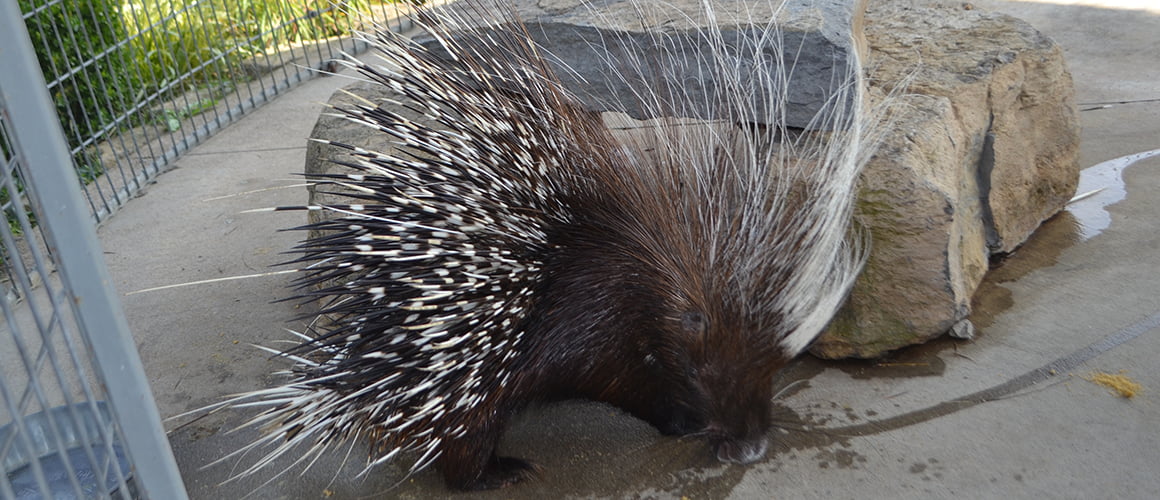
The crested porcupine (Hystrix cristata) is a species of rodent in the Hystricidae family.[2] It is extant in mainland Italy, Sicily, North Africa and sub-Saharan Africa.
Physical Description
Hystrix cristata is part of the family Hystricidae. The more common name for this species is the crested porcupine. The crested porcupine has an average head and body length of about 600-900 mm. Almost the entire body is covered with bristles which are either dark brown or black and rather coarse. This mammal is recognizable by the quills that run along the head, nape, and back that can be raised into a crest. Hence the name crested porcupine. There are also some sturdier quills which are about 350 mm in length and run along the sides and back half of the body. These sturdier quills are used, for the most part, for defense and are usually marked with light and dark bands which alternate, these are not firmly attached. This porcupine has a shorter tail which has rattle quills at the end. The rattle quills broaden at the terminal end and the broad portion is hollow with thin walls. When these quills are vibrated they produce a hiss-like rattle.
The front feet of the crested porcupine have four developed and clawed digits with a regressed thumb, the rear feet have five. The paws have naked and padded soles and have a plantigrade gait. The ears are external and both the eyes and ears are very small with long vibrissae on its head. The skull is specific in many ways, first the infraorbital foramen is greatly enlarged so that portions of the masseter extend through it and attach from the frontal side surface of the snout. Second the angular process is inflected on the lower jaw, thirdly the nasal cavity is enlarged. Prominent pockets create enlarged areas of attachment for chewing muscles. Collar bones are very much reduced, and there are one incisor, one premolar and three molars.
Habitat & Range
The crested porcupine is found in Italy, North Africa and sub-Saharan Africa. In the Mediterranean it is known from mainland Italy and the island of Sicily, Morocco, Algeria, Tunisia; there are also records from Libya, and along the Egyptian coast. It has been recorded from sea level to 2550 m in Moroccan Anti Atlas. It is sometimes asserted that the porcupine was introduced to Italy by the Romans, but fossil and sub fossil remains suggest it was possibly present in Europe in the Upper Pleistocene.
Ecology & Behavior
The crested porcupine is a terrestrial mammal; they very seldom climb trees, but can swim. They are nocturnal and monogamous. The crested porcupine takes care of the young for a long time and small family groups consist of the adult pair and young of various ages. In defense, when disturbed they raise and fan their quills to make themselves look bigger. If continually bothered, the crested porcupine will stamp its feet, whir the quills, and charge the disturber back end first trying to stab the enemy with the thicker, shorter quills. These attacks are known to have killed lions, leopards, hyenas, and even humans.
Reproduction
Population
Field Trips, Birthday Parties & More!
Stay up to date on the latest listings, auctions and news.