

CLOSE
Connect with us!

Open for the 2026 Season

We are open for the 2026 Season. Come Visit the Animals!

Our Animals
Go Back To Main Ducks & Swans Page
Mallard Duck
Anas platyrhynchos
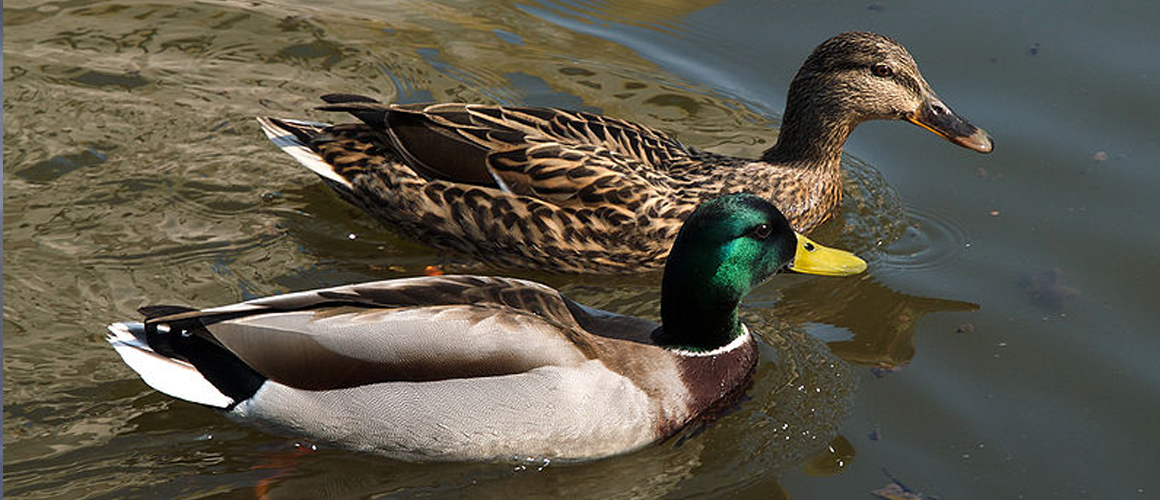
Mallard Ducks at The Farm at Walnut Creek
Description

The Mallard, or Wild duck (Anas platyrhynchos), probably the best-known and most recognizable of all ducks, is a dabbling duck which breeds throughout the temperate and sub-tropical areas of North America, Europe, Asia, New Zealand (where it is currently the most common duck species), and Australia. It is strongly migratory in the northern parts of its breeding range, and winters farther south. For example, in North America it winters south to Mexico, but also regularly strays into Central America and the Caribbean between September and May.

The male birds have bright green head, while the female is light brown. The Mallard lives in wetlands, eats water plants, and is gregarious. The Mallard is the ancestor of all domestic ducks, and can interbreed with other species of genus Anas. This interbreeding is causing rarer species of ducks to become genetically diluted.


Physical Description
The Mallard is 56–65 cm long, has a wingspan of 81–98 cm, and weighs 0.9–1.2 kg. The breeding male is unmistakable, with a bright green head, black rear end and a yellowish orange (can also contain some red) bill tipped with black (as opposed to the dark brown bill in females). The female Mallard is light brown, like most female dabbling ducks. However, both the female and male Mallards have distinct purple speculum edged with white, prominent in flight or at rest (though temporarily shed during the annual summer moult). In non-breeding (eclipse) plumage the drake becomes drab, looking more like the female, but still distinguishable by its yellow bill and reddish breast. The Mallard is a rare example of both Allen's Rule and Bergmann's Rule in birds. Bergmann's Rule, which states that polar forms tend to be larger than related ones from warmer climates, has numerous examples in birds. Allen's Rule says that appendages like ears tend to be smaller in polar forms to minimize heat loss, and larger in tropical and desert equivalents to facilitate heat diffusion, and that the polar taxa are stockier overall. Examples of this rule in birds are rare, as they lack external ears. However, the bill of ducks is very well supplied with blood vessels and is vulnerable to cold. A noisy species, the male has a nasal call, the female has a "quack" stereotypically associated with ducks.
Ecology & Behavior
Mallard ducks inhabit most wetlands, including parks, small ponds and rivers, and usually feed by dabbling for plant food or grazing, though there are reports of Mallards eating frogs. They will usually, but not always, nest near open water. Mallards are highly gregarious outside of the breeding season and will form large flocks, which are known as a sords.[4]
Reproduction
Field Trips, Birthday Parties & More!
Stay up to date on the latest listings, auctions and news.
Join Now

Connect With Us

Contact Us

15100 Mooresville Rd
Mooresville, NC 28115
PH: (704) 663-5100
Email Us Here
Terms of Use
Privacy Policy
Copyright © 2023 Lazy 5 Ranch - All Rights Reserved
Web Design by The Web Factors
cross